



Beginn des Seitenbereichs:
Seitenbereiche:

  • Zum Inhalt (Zugriffstaste 1)
  • Zur Positionsanzeige (Zugriffstaste 2)
  • Zur Hauptnavigation (Zugriffstaste 3)
  • Zur Unternavigation (Zugriffstaste 4)
  • Zu den Zusatzinformationen (Zugriffstaste 5)
  • Zu den Seiteneinstellungen (Benutzer/Sprache) (Zugriffstaste 8)
  • Zur Suche (Zugriffstaste 9)

Ende dieses Seitenbereichs. Zur Übersicht der Seitenbereiche

Beginn des Seitenbereichs:
Seiteneinstellungen:

Deutsch de
English en
Suche
Anmelden

Ende dieses Seitenbereichs. Zur Übersicht der Seitenbereiche

Beginn des Seitenbereichs:
Suche:

Suche nach Details rund um die Uni Graz
Schließen

Ende dieses Seitenbereichs. Zur Übersicht der Seitenbereiche


Suchen

Beginn des Seitenbereichs:
Hauptnavigation:

Seitennavigation:

  • Universität

    Universität
    • Die Uni Graz im Portrait
    • Organisation
    • Strategie und Qualität
    • Fakultäten
    • Universitätsbibliothek
    • Jobs
    • Campus
    Lösungen für die Welt von morgen entwickeln – das ist unsere Mission. Unsere Studierenden und unsere Forscher:innen stellen sich den großen Herausforderungen der Gesellschaft und tragen das Wissen hinaus.
  • Forschungsprofil

    Forschungsprofil
    • Unsere Expertise
    • Forschungsfragen
    • Forschungsportal
    • Forschung fördern
    • Forschungstransfer
    • Ethik in der Forschung
    • Kommission für wissenschaftliche Integrität
    Wissenschaftliche Exzellenz und Mut, neue Wege zu gehen. Forschung an der Universität Graz schafft die Grundlagen dafür, die Zukunft lebenswert zu gestalten.
  • Studium

    Studium
    • Studieninteressierte
    • Infos für Studierende
    • Aufnahmeverfahren
    • Lehramt Aufnahmeverfahren
  • Community

    Community
    • International
    • Am Standort
    • Forschung und Wirtschaft
    • Absolvent:innen
    Die Universität Graz ist Drehscheibe für internationale Forschung, Vernetzung von Wissenschaft und Wirtschaft sowie für Austausch und Kooperation in den Bereichen Studium und Lehre.
Jetzt aktuell
  • Aufnahmeverfahren 2026
  • Uni Vibes - das Fest
  • Jetzt die "Youni"-App holen
  • Klimaneutrale Uni Graz
  • Forscher:innen gefragt
  • Arbeitgeberin Uni Graz
Menüband schließen

Ende dieses Seitenbereichs. Zur Übersicht der Seitenbereiche

Beginn des Seitenbereichs:
Sie befinden sich hier:

Universität Graz ARQUS Neuigkeiten What’s the link between inequality and climate change?
  • Über Arqus
  • Unser Angebot
  • Offene Calls
  • Kontakt
  • Neuigkeiten

Ende dieses Seitenbereichs. Zur Übersicht der Seitenbereiche

Montag, 03.07.2023

What’s the link between inequality and climate change?

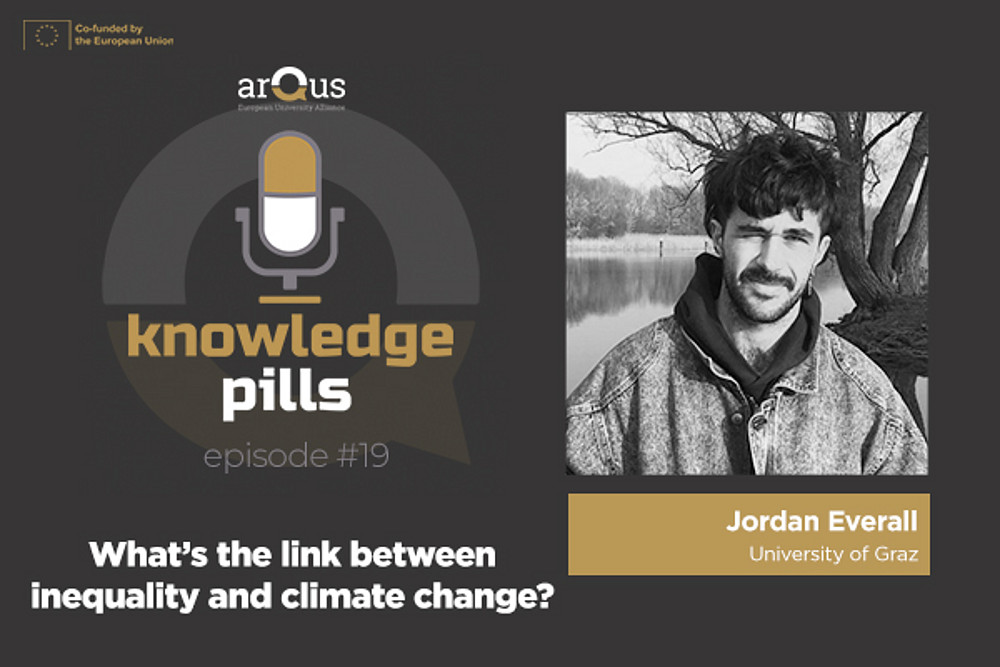
arqus-knowledge-pills-19-3x2-600

For the 19th episode of the Arqus Knowledge Pills, we welcomed an expert on “social tipping”: Jordan Everall. He is a member of the research group “Social Complexity & System Transformation” at the University of Graz.

Social tipping processes describe how social, political, economic or technological systems can move rapidly into a new system state if cascading positive feedback mechanisms are triggered.

In this episode, we discuss his research on rapid social change and its connection to climate change. Jordan explains also how to quantify inequality and how these topics are all connected before he answers the tricky question: “Is it still possible to save the Earth?”.

https://podcasters.spotify.com/pod/show/arqus-alliance/episodes/19-Whats-the-link-between-inequality-and-climate-change-e26bedd

Learn more about Jordan Everall:

Jordan was born in Australia, studied his bachelor’s there, and then moved to Berlin at the end of his Master’s in Environmental Science to finish it at the Frei Universität in Berlin. After this he worked as a research assistant in areas that included agricultural modelling and techno-economic assessment, the latter being at PIK (Potsdam Institute für Klima..). He decided after working at PIK and attending a lecture from Ilona Otto there that he would like to do his PhD in the area of social tipping, and more broadly social transformation, but from a modelling or quantitative perspective, which brought him to what he is currently doing.

Jordan researches social tipping and rapid social transformation processes using the tools of network science and agent-based modelling. In doing this he focuses on inequality in the ability of individuals to initiate or facilitate these processes, or their Agency. Whether it be the ultra-wealthy, social-media influencers, politicians, or your average Jane. This inequality in the agency is often influenced by wealth, status, and occupation, which also require consideration. In addition to quantifying these differences, he wants to find out how we can use those with more influence as a lever in society, and speed these processes up.

The episodes of the “Arqus Knowledge Pills” are published on a regular basis and can be subscribed to on Spotify and other platforms (see below). Doriane Duvault (Université Claude Bernard Lyon 1) and Josephine Petzold (Leipzig University) are the moderators that lead listeners through each episode.


Spotify for podcasters.

Apple podcasts.

Pocket Casts.

RadioPublic.

Breaker.

Google Podcasts.

Weitere Artikel

Tell your (green) mobility story!

Are you an exchange student currently navigating travel arrangements or already living your eco-friendly adventure abroad? Tell Your Mobility Story (TYMS) is back, and this year, we are going fully green!

New Arqus micro-credential

Join the new Arqus micro-credential: Advanced creative thinking and communication

Arqus Twinning in Graz

As part of the Arqus Twinning programme, the University of Graz recently hosted a week-long academic and cultural exchange under the title “Greening Transitions with AI: Climate Employment and Sustainability in Action.” The programme welcomed five students and two professors from the University of Minho for an intensive week of learning, discussion, and collaboration.

9 Months, 9 Universities

Join the new webinar in the “9 Months, 9 Universities” series on sign languages and its relation with multilingualism

Beginn des Seitenbereichs:
Zusatzinformationen:

Universität Graz
Universitätsplatz 3
8010 Graz
  • Anfahrt und Kontakt
  • Kommunikation und Öffentlichkeitsarbeit
  • Moodle
  • UNIGRAZonline
  • Impressum
  • Datenschutzerklärung
  • Cookie-Einstellungen
  • Barrierefreiheitserklärung
Wetterstation
Uni Graz

Ende dieses Seitenbereichs. Zur Übersicht der Seitenbereiche

Ende dieses Seitenbereichs. Zur Übersicht der Seitenbereiche

Beginn des Seitenbereichs:

Ende dieses Seitenbereichs. Zur Übersicht der Seitenbereiche