



Beginn des Seitenbereichs:
Seitenbereiche:

  • Zum Inhalt (Zugriffstaste 1)
  • Zur Positionsanzeige (Zugriffstaste 2)
  • Zur Hauptnavigation (Zugriffstaste 3)
  • Zur Unternavigation (Zugriffstaste 4)
  • Zu den Zusatzinformationen (Zugriffstaste 5)
  • Zu den Seiteneinstellungen (Benutzer/Sprache) (Zugriffstaste 8)
  • Zur Suche (Zugriffstaste 9)

Ende dieses Seitenbereichs. Zur Übersicht der Seitenbereiche

Beginn des Seitenbereichs:
Seiteneinstellungen:

Deutsch de
English en
Suche
Anmelden

Ende dieses Seitenbereichs. Zur Übersicht der Seitenbereiche

Beginn des Seitenbereichs:
Suche:

Suche nach Details rund um die Uni Graz
Schließen

Ende dieses Seitenbereichs. Zur Übersicht der Seitenbereiche


Suchen

Beginn des Seitenbereichs:
Hauptnavigation:

Seitennavigation:

  • Universität

    Universität
    • Die Uni Graz im Portrait
    • Organisation
    • Strategie und Qualität
    • Fakultäten
    • Universitätsbibliothek
    • Jobs
    • Campus
    Lösungen für die Welt von morgen entwickeln – das ist unsere Mission. Unsere Studierenden und unsere Forscher:innen stellen sich den großen Herausforderungen der Gesellschaft und tragen das Wissen hinaus.
  • Forschungsprofil

    Forschungsprofil
    • Unsere Expertise
    • Forschungsfragen
    • Forschungsportal
    • Forschung fördern
    • Forschungstransfer
    • Ethik in der Forschung
    • Kommission für wissenschaftliche Integrität
    Wissenschaftliche Exzellenz und Mut, neue Wege zu gehen. Forschung an der Universität Graz schafft die Grundlagen dafür, die Zukunft lebenswert zu gestalten.
  • Studium

    Studium
    • Studieninteressierte
    • Infos für Studierende
    • Aufnahmeverfahren
    • Lehramt Aufnahmeverfahren
  • Community

    Community
    • International
    • Am Standort
    • Forschung und Wirtschaft
    • Absolvent:innen
    Die Universität Graz ist Drehscheibe für internationale Forschung, Vernetzung von Wissenschaft und Wirtschaft sowie für Austausch und Kooperation in den Bereichen Studium und Lehre.
Jetzt aktuell
  • Aufnahmeverfahren 2026
  • Uni Vibes - das Fest
  • Jetzt die "Youni"-App holen
  • Klimaneutrale Uni Graz
  • Forscher:innen gefragt
  • Arbeitgeberin Uni Graz
Menüband schließen

Ende dieses Seitenbereichs. Zur Übersicht der Seitenbereiche

Beginn des Seitenbereichs:
Sie befinden sich hier:

Universität Graz ARQUS Neuigkeiten New podcast episode: Enjoy it and learn more about how climate change affects whales by listening Professor Sandro Mazzariol
  • Über Arqus
  • Unser Angebot
  • Offene Calls
  • Kontakt
  • Neuigkeiten

Ende dieses Seitenbereichs. Zur Übersicht der Seitenbereiche

Dienstag, 06.06.2023

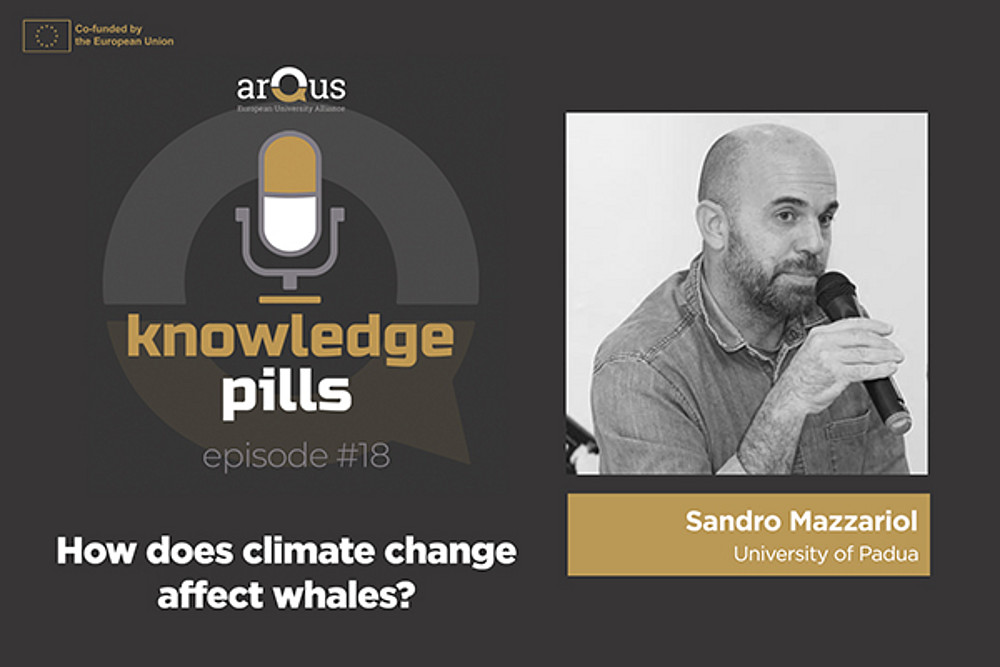
New podcast episode: Enjoy it and learn more about how climate change affects whales by listening Professor Sandro Mazzariol

Professor Sandro Mazzariol

For the 18th episode of the Arqus Knowledge Pills, we go under water! Professor of Veterinary Pathology at the University of Padua, Sandro Mazzariol, explains the human impact on Cetaceans.

In his podcast, this specialist in marina mammals tells us more about the consequences of climate change on these creatures. He talks us through a marine mammal rescue and the complications this can lead to. On a positive note, he tells us his favourite species of whale and refers to it as an alien.

Professor Mazzariol helps us to know and understand the main ways humans are harmful to animals. As a scientist and activist very active in the fight against whaling and in the rescue of marine mammals, he describes how he combines these two roles, and how a whale rescue practically works. In addition, Professor focuses on his position as Chair of the International Whaling Commission Expert Panel, telling us how his activity in this international setting differs from the work of colleagues in other parts of the world.


#18: How does climate change affect whales? - Arqus Knowledge Pills | Podcast on Spotify

Learn more about Professor Sandro Mazzariol:

He was born on 18th of May 1976 in Portogruaro, Italy. In 2002 he graduated in Veterinary Medicine at the University of Padua. In 2005, he got a PhD in Public Health, Veterinary Hygiene and Animal Productions at the University of Padua. Since then, he has been working as a Professor of General Pathology and Anatomical Veterinary Pathology with a working visit to the Faculty of Veterinary Medicine at Texas A&M University (USA) in 2005.

His main research fields are the study of marine mammals’ pathology and, in general, of free-ranging and captive wildlife, focusing on anthropic impaction and related diseases. His teaching is mainly focused on diseases and pathology of wild and farm animals.

Since 2010 he’s been the coordinator of the Cetaceans Strandings Emergency Response Team (CERT) for the Italian Ministry of the Environment and he’s a member of the Italian Delegation to the Scientific Committee of the International Whaling Commission.

In 2017 he was nominated as Chair of the International Whaling Commission Expert Panel. In 2019 he became part of the IUCN Cetacean’s specialist group.

Finally, he’s the author of more than 85 peer-reviewed papers in international journals, book chapters, and national reports.


The episodes of the “Arqus Knowledge Pills” are published on a regular basis and can be subscribed to on Spotify and other platforms (see below). Doriane Duvault (Université Claude Bernard Lyon 1) and Josephine Petzold (Leipzig University) are the moderators that lead listeners through each episode.


Spotify for podcasters.

Apple podcasts.

Pocket Casts.

RadioPublic.

Breaker.

Google Podcasts.

Weitere Artikel

Tell your (green) mobility story!

Are you an exchange student currently navigating travel arrangements or already living your eco-friendly adventure abroad? Tell Your Mobility Story (TYMS) is back, and this year, we are going fully green!

New Arqus micro-credential

Join the new Arqus micro-credential: Advanced creative thinking and communication

Arqus Twinning in Graz

As part of the Arqus Twinning programme, the University of Graz recently hosted a week-long academic and cultural exchange under the title “Greening Transitions with AI: Climate Employment and Sustainability in Action.” The programme welcomed five students and two professors from the University of Minho for an intensive week of learning, discussion, and collaboration.

9 Months, 9 Universities

Join the new webinar in the “9 Months, 9 Universities” series on sign languages and its relation with multilingualism

Beginn des Seitenbereichs:
Zusatzinformationen:

Universität Graz
Universitätsplatz 3
8010 Graz
  • Anfahrt und Kontakt
  • Kommunikation und Öffentlichkeitsarbeit
  • Moodle
  • UNIGRAZonline
  • Impressum
  • Datenschutzerklärung
  • Cookie-Einstellungen
  • Barrierefreiheitserklärung
Wetterstation
Uni Graz

Ende dieses Seitenbereichs. Zur Übersicht der Seitenbereiche

Ende dieses Seitenbereichs. Zur Übersicht der Seitenbereiche

Beginn des Seitenbereichs:

Ende dieses Seitenbereichs. Zur Übersicht der Seitenbereiche