Begin of page section:
Page sections:

  • Go to contents (Accesskey 1)
  • Go to position marker (Accesskey 2)
  • Go to main navigation (Accesskey 3)
  • Go to sub navigation (Accesskey 4)
  • Go to additional information (Accesskey 5)
  • Go to page settings (user/language) (Accesskey 8)
  • Go to search (Accesskey 9)

End of this page section. Go to overview of page sections

Begin of page section:
Page settings:

English en
Deutsch de
Search
Login

End of this page section. Go to overview of page sections

Begin of page section:
Search:

Search for details about Uni Graz
Close

End of this page section. Go to overview of page sections


Search

Begin of page section:
Main navigation:

Page navigation:

  • University

    University
    • About the University
    • Organisation
    • Faculties
    • Library
    • Working at University of Graz
    • Campus
    Developing solutions for the world of tomorrow - that is our mission. Our students and our researchers take on the great challenges of society and carry the knowledge out.
  • Research Profile

    Research Profile
    • Our Expertise
    • Research Questions
    • Research Portal
    • Promoting Research
    • Research Transfer
    • Ethics in Research
    • Commission for Scientific Integrity
    Scientific excellence and the courage to break new ground. Research at the University of Graz creates the foundations for making the future worth living.
  • Studies

    Studies
    • Prospective Students
    • Students
  • Community

    Community
    • International
    • Location
    • Research and Business
    • Alumni
    The University of Graz is a hub for international research and brings together scientists and business experts. Moreover, it fosters the exchange and cooperation in study and teaching.
  • Spotlight
Topics
  • Sustainable University
  • Researchers answer
  • Work for us
Close menu

End of this page section. Go to overview of page sections

Begin of page section:
You are here:

University of Graz ARQUS News Faces of Arqus #2: AL6
  • About Arqus
  • Our Offer
  • Open Calls
  • Contact us
  • News

End of this page section. Go to overview of page sections

Thursday, 04 February 2021

Faces of Arqus #2: AL6

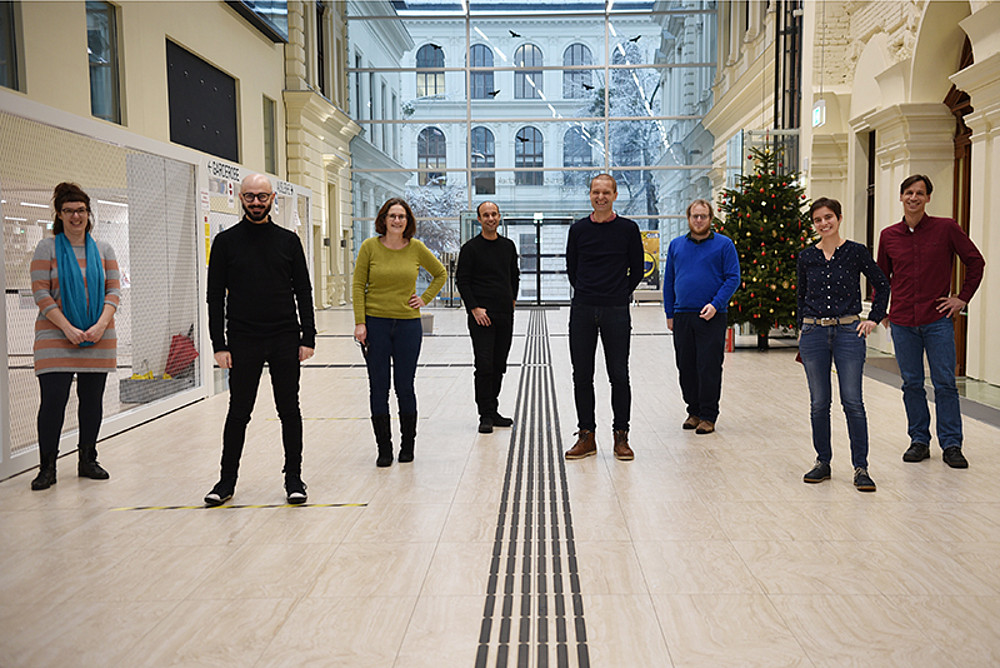
 The AL6 Team (from left): Johanna Stadlbauer, Gerald Lind, Corinne von der Hellen, Mario Müller, Vice-Rector Christof Gattringer, Philipp Weißert, Hildrun Walter and Christian Kaier. Mario Müller (Office of Research Management and Service) over his responsibilities as AL6 Chair to Philipp Weißert in September 2020 and has been a referee in Task Force 6.12 Postdoc Pursuit since December. Corinne von der Hellen supports colleagues Stadlbauer and Lind both in their DocService agendas and in their Arqus agendas. A double interview with Vice-Rector Christof Gattringer and Vice-Rector Petra Schaper-Rinkel will be published on 11 March. Photo: Uni Graz/Leljak.

The AL6 Team (from left): Johanna Stadlbauer, Gerald Lind, Corinne von der Hellen, Mario Müller, Vice-Rector Christof Gattringer, Philipp Weißert, Hildrun Walter and Christian Kaier. Mario Müller (Office of Research Management and Service) over his responsibilities as AL6 Chair to Philipp Weißert in September 2020 and has been a referee in Task Force 6.12 Postdoc Pursuit since December. Corinne von der Hellen supports colleagues Stadlbauer and Lind both in their DocService agendas and in their Arqus agendas. A double interview with Vice-Rector Christof Gattringer and Vice-Rector Petra Schaper-Rinkel will be published on 11 March. Photo: Uni Graz/Leljak.

Today: Interview with the team of Action Line 6 (AL6): “Research Support and Early Stage Researcher Development”

Following a challenging 2020, Arqus – the European University Alliance, comprising the University of Graz and six partners – has some ambitious plans for 2021. Over the next few weeks, the people at the University of Graz who are involved in the Arqus alliance will be reporting on what it has achieved so far and what objectives it has set itself for this year.

Today: Action Line 6 (AL6): “Research Support and Early Stage Researcher Development” 
Contacts at the University of Graz: Chair Philipp Weißert (Office of Research Management and Service) Johanna Stadlbauer, Gerald Lind (DocService); Hildrun Walter (7th faculty) and Christian Kaier (publication services). 

Each of the seven universities in the Arqus alliance has the main responsibility for one Action Line. Graz is in charge of the AL6. This is intended to strengthen scientific cooperation between the seven institutions, support early career researchers in building a career, and at the same time increase the value that the population attaches to research. What has Arqus achieved in these three areas during its first year?  

PW: We have created a ClusterMap that visualises the strategic or scientific orientations of the seven Arqus universities, including their various core research areas. In this way, we gained an overview of some of the collaborations that already exist and also saw where new fields of cooperation could open up. A particular success was that the application for the project “Arqus Research & Innovation” (in short, Arqus R.I.) – which we submitted as an alliance as part of the EU Horizon 2020 framework programme – was approved and funded by the EU with two million euros. In Arqus R.I., we are working together on several topics, which all centre around the two big buzzwords Artificial Intelligence/Digital Transformation and Green Deal/Climate Change. 

GL: To support Early Stage Researchers in building their scientific careers, we have announced two “calls” within the Arqus alliance. On the one hand, doctoral groups could apply for funding in order to initiate sustainable research and training collaborations in the form of site visits and joint activities. On the other, researchers and early career researchers at the various Arqus partner universities were able to apply for funding for short or medium to long-term research stays at these partner universities. The great interest in both job advertisements is also reflected in the number of funding awards. In total, we were able to promise funding to 21 individuals and five doctoral groups at the University of Graz. There will be a third “call” this year, which will also be targeted at all disciplines. The aim of the alliance is to advance open interdisciplinary and cross-disciplinary approaches to research.

HW: Expanding the reach of the sciences, on the other hand, is still in its infancy at some of the seven universities. First of all, it was important to establish a common understanding of the definition and framework of Open Science. Firstly, we want to raise awareness among researchers and students for this particular topic and make them aware of the added value of good Open Science practices. We also looked at which Open Science areas are particularly important for all Arqus partners and are now working on comparing the implementations at the various universities as well as developing concrete, mutual objectives.


Please share three items with us that you have planned in your individual areas of responsibility for 2021.

PW:
Firstly, support researchers when filling out highly competitive applications. Secondly, develop a database for high-level infrastructure, with the aim of sharing powerful laboratory equipment in the future. Thirdly, organise a networking event for both administrative staff and research support staff.

JS: Firstly, create exchange platforms for junior researchers; a summer school and a career week for the non-university job market are already planned for October. Secondly, set up a mentoring programme in which scientists and experts established in their fields share their know-how with PhD and postdoc students. Thirdly, maintain the prevailing positive mood within the alliance! 

CK: Firstly, share best practices. Secondly, continue working on the Arqus position paper on Open Science and Citizen Science. Thirdly, finally meet our cooperation partners in person this year!

>> Retrospective: Faces of Arqus#1: AL6 (2019)

created by Gerhild Leljak

Related news

Human Rights Café - Voices from the peripheries

Insights on Human Rights and Democracy. Join the next Human Rights Café in Graz!

Arqus Summer School on Teaching Innovation 2026

The University of Wrocław will host the 2026 Arqus Summer School on Teaching Innovation (SSoTI) from 20 to 23 July 2026, bringing together academics from across the Arqus Alliance to explore “Language as a multifaceted tool in the teaching and learning environment”.

Join the Arqus MOOC on Cybersecurity for citizens and professionals

Arqus has launched a new Massive Open Online Course (MOOC) titled “Cybersecurity: A citizen and professional guide”, now freely available to learners worldwide. Designed to equip both general public and professionals with essential digital security skills, the course reflects the Alliance’s commitment to digital empowerment.

Human Rights Café - become a volunteer!

Become a volunteer for the next transnational session of the student-led Human Rights Café. Apply now!

Begin of page section:
Additional information:

University of Graz
Universitaetsplatz 3
8010 Graz
Austria
  • Contact
  • Web Editors
  • Moodle
  • UNIGRAZonline
  • Imprint
  • Data Protection Declaration
  • Accessibility Declaration
Weatherstation
Uni Graz

End of this page section. Go to overview of page sections

End of this page section. Go to overview of page sections

Begin of page section:

End of this page section. Go to overview of page sections